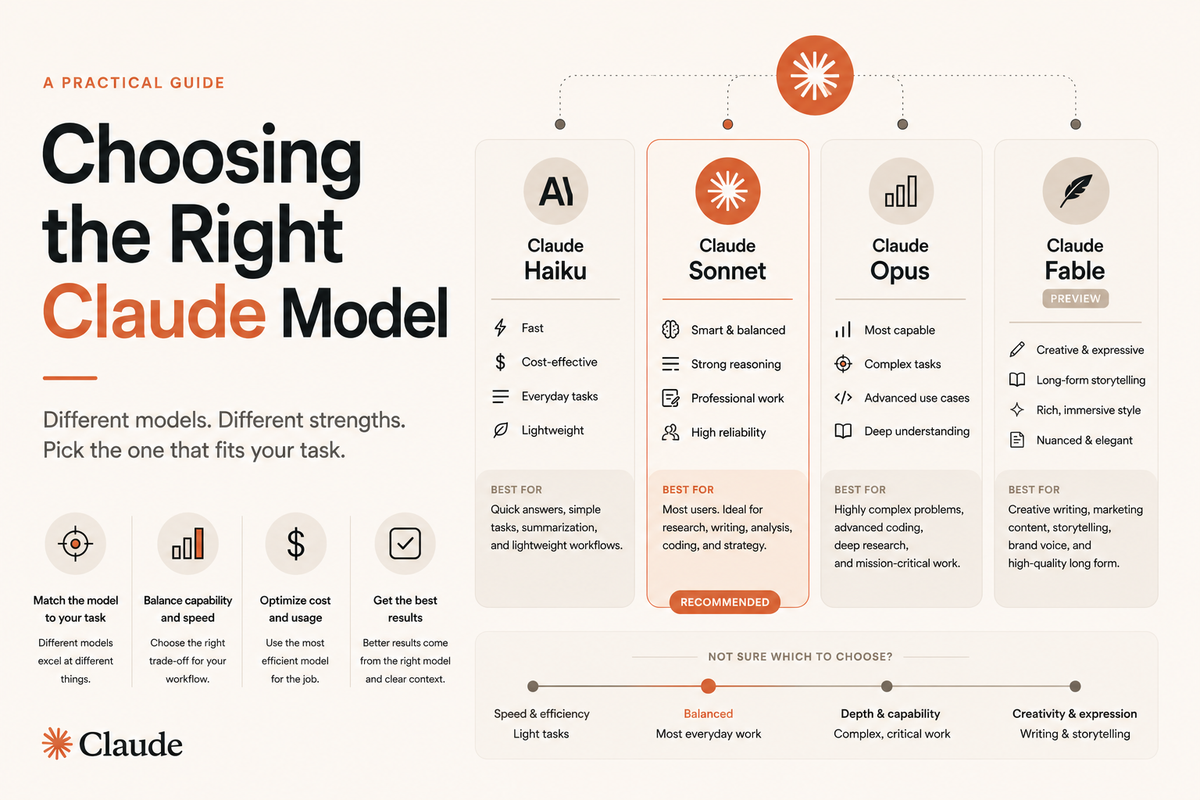
Open the model picker inside Claude and you will see a few names: Haiku, Sonnet, Opus, sometimes Fable. Most people pick whichever one is selected by default and never touch it again.
That works fine most of the time, but understanding what each model is actually built for helps you stop wasting time on tasks that need a stronger model, and stop overpaying attention (and money, on the API side) on tasks that do not.
The three tiers, and what they are actually for
Anthropic builds Claude in tiers, not as one model with settings. Each tier trades off speed, depth, and cost differently.
Haiku is the fast, light one. It is built for tasks with a clear, well-defined answer: quick questions, formatting, summarizing something short, simple edits. You will barely notice it thinking. The trade-off is that it does not go deep on multi-step reasoning, so if a task needs Claude to hold several threads together at once, Haiku is not where you want to be.
Sonnet is the daily driver. It sits in the middle and is the model most people should be using for most of their work: writing, research, planning, coding, analyzing a document, working through a problem with some back and forth. It is currently set as Claude's default model, and for good reason. Anthropic's own model documentation says Sonnet 5 now matches Opus on most knowledge-work tasks while costing less, which is a fairly direct way of saying: you probably do not need to go higher unless the task specifically calls for it.
Opus is the model built for the hardest 10 to 15 percent of tasks. Long agentic chains, genuinely complex code across many files, decisions where getting it wrong is expensive. It thinks longer and costs more, and that extra depth only pays off when the task actually needs it.
Fable sits above Opus, available to Max and higher subscription tiers. It is built for the rare session where you want the most capable model Anthropic currently offers, and your plan already covers it. Most people will not need to reach for this often, but it exists for a reason when the work genuinely calls for peak capability.
The mistake most people make
The instinct is to assume more powerful always means better output. It does not.
A model built for deep reasoning is not automatically better at drafting a quick Instagram caption. It is often slower for no real benefit, and on the API side, meaningfully more expensive for the same result.
The better way to think about it: match the model to how much the task actually needs to think, not to how important the task feels to you.
A practical example
Say you are writing a Hinglish reel script, checking a contract clause, and asking Claude to summarize a long PDF you just received.
The reel script is a Sonnet task. It needs tone, structure, and a bit of creative judgment, but it is not solving a hard multi-step problem.
The PDF summary can often be handled by Haiku if the document is short and the ask is simple. If it is a fifty page document and you need Claude to track obligations, exceptions, and cross-references across it, that is closer to an Opus task, because the value is in holding many threads together correctly, not in speed.
The contract clause question depends on the stakes. If it is a quick sanity check, Sonnet is fine. If getting it wrong has a real cost, that is exactly the kind of task Opus exists for.
The practical takeaway
Default to Sonnet. It covers almost everything you will throw at Claude in a normal week, and Anthropic has clearly built it to be the sensible default rather than the compromise option. Drop to Haiku when the task is simple and speed matters more than depth. Reach for Opus only when a task is genuinely hard, and getting it wrong would cost you more than the extra time. Fable is there for the rare case where you want the ceiling, not the default.
Do not pick a model because its name sounds more impressive. Pick it because the task in front of you actually needs what that model is built for.